
Sathguru Swami Gnanananda Giri
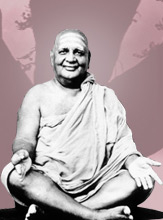
Swami Sri Gnanananda Giri is believed to be born in the early 8th century. He is the Chief Disciple of Sri Sivaratna Giri Swamigal and also one of the Peetathipathis (leader) of the Jyothir Matam, one of the four Matams established by Adi Sankarar. This lineage of Peetathipathis is also commonly known as the ‘Giri’ Paramparai as seen from the Peetathipathis’ name which ends with ‘Giri’.
The Birth of Swami Gnanananda Giri is not clearly known but his birth date is celebrated each year on the birth star of Kritika in the Tamil month of Thai, (January). He is also believed to be born in the village Mangalapuri in North Kanara District of Karnataka to an orthodox Brahmin couple, Venkoba Ganapati and Srimati Sakku Bai. Gnanananda was named Subramanyam at birth, and left his home at a very early age.
At his young age, he was driven to Pandharpur with an urge to know the “self”. It is in this historic place, that swami was guided to meet his Guru, Swami Sivaratna Giri of Jyotirmutt, one of the four mutts established by His holiness Adi Sankara himself. Swami Sivaratna Giri accepted this young boy as his disciple and swami then followed his Guru like a shadow and derived great delight in serving him. After swami attained proficiency in “Ashtanga Yoga, Hindu scriptures, upanishadic truths etc., swami was given holy order of “Sanyasa” by his Guru and was named “Sri Gnanananda Giri” into the “Giri” order of Jyotir Mutt. Later, after Mahasamadhi of his Guru, Swami adorned the peetam of Jyotir Mutt 6th lineage of the Peetam of Jagadguru Totakacharya for some time. However he nominated one Ananda Giri in his place and retired to the height of the Himalayas for penance.
Gnanananda spent many years at the sacred spot of Gangotri and icy caves of the Himalayas in intense tapas. After a long period of seclusion, swami traveled extensively on foot, spanning the whole of India, Tibet, Nepal, Burma and Sir Lanka. Finally, swami is believed to have returned to Southern India and from around 1966, swami permanently stayed at Thapovanam. Before that, swami established ashrams at Attyampatti, Siddhilingamadam, Dalmiapuram and also one at Yercaud (established later) known as “Pranavanilayam”.
The most famous ashram named Sri Gnanananda Tapovanam is situated two miles away from Tirukkoyilur. Gnanananda built temples for the deities of Gnanaganesa, Gnanaskandan, Gananapurisa, Gnanambika, GnanaMahalaksmi, Gnana Venugopala, Gnana Bhairavar and Gnana Anjaneyan, Durga, Navagraha and Chandikeshwara in Tapovanam. The deities were given chaitanya (power) by Swami through his graceful look and sankalpa, and the deities today shower their “anugraha” to all those devotees who pray and surrender. The Ashram today attracts devotees and disciples from far and near, where one immerses into “Guru bhakti”. Prayer and worship, through singing of hymns and stress on “guru bhakti” have been the marked features of life at Thapovanam.
The ashram that was constructed in Yercaud, a hill station near Salem was called “Pranavanilayam”. This was a retreat for contemplatives. Swami Gnanananda Giri wanted to develop it as a center for comparative religion. In contrast to Tapovanam, no rituals were permitted in Yercaud. The central emphasis was on meditation and dhyana.
Swami Gnanananda Giri was well-versed in the Advaita Vedanta. He taught a number of paths based on the aptitude of his disciples. Therefore some of the disciples are conversant in the Jnana Marga while others are karma margis and still others follow Bhakti Marga. Some of his disciples are conversant in the philosophy of Shankara and Kant. Swami Vidyananda Giri, his senior-most monastic disciple, was a profound scholar and linguist and brought out Tamil translations of Shankara’s commentaries on the Bhagavad Gita and the Upanishads. He also made available Tamil versions of famous Advaitic texts like Sanatsujatiyam. He trained a wide range of followers in Advaitic Nidhidhyasana. Another of his lineage, Swami Satyananda Giri was associated with Franklin Merrell Wolff and taught his method of Interoceptive Knowledge. He had written several books on the philosophy and history of India.
There is a traditional way of praying by chanting in all ashrams except Yercaud. Here, as we saw, external worship is banned. In Pranavanilayam, there are pictures of Sri Swami Gnanananda, Buddha, Sri Vivekananda, the sacred heart of Jesus and a picture of Mecca. Devotees and monks there devote their time to do research and meditate. You can still see these ashrams in India. These ashrams carry forward Gnanananda Giri Swami’s message.